Get In Touch

 July, 22
An industrial vehicle may look simple from a distance. It moves material, carries load, follows fixed routes, and returns for service after hard use.
Once the same vehicle moves to an electric platform, the familiar parts of the job begin to change. Weight, charging time, torque delivery, heat, and maintenance all need a closer look. A smoother shift usually starts with the work the vehicle already performs every day.
The current duty cycle gives you the clearest starting point for electrification.
You may want to study run hours, load weight, route length, idle time, floor condition, incline, heat, dust, and vibration before you compare motors or battery packs.
A factory tug that moves across a flat indoor route has a very different profile from a site transporter working outside with heavier loads.
The shift becomes easier when your team understands which parts of the existing vehicle routine will stay stable and which parts will change after electrification.
A phased shift helps your team learn from one platform before rolling changes across the full product range.
Many industrial vehicle companies begin with a use case that has predictable routes, stable loads, and clear charging breaks during the workday.
This could be a factory utility vehicle, electric industrial transporter, warehouse mover, compact cargo unit, or another controlled application.
A smaller first phase gives engineering, production, service, and procurement teams enough room to test the platform properly before the next vehicle enters the plan.
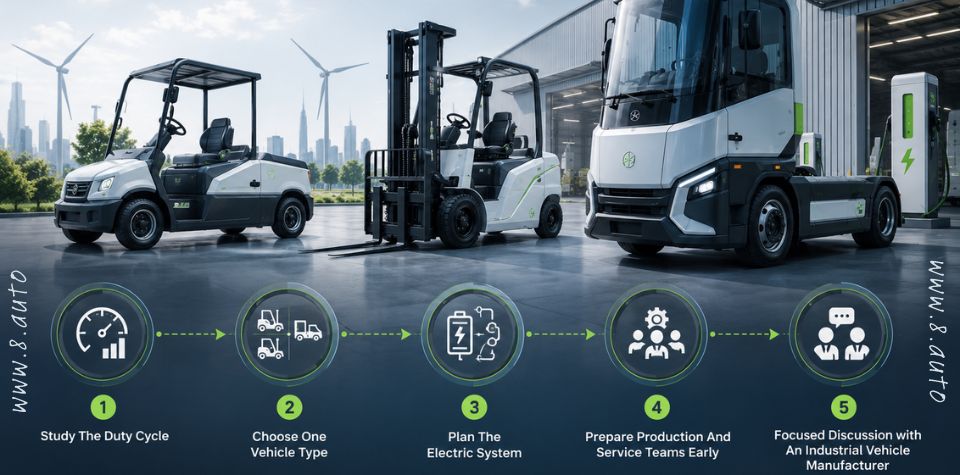
An electric platform works best when the battery, motor, charger, control unit, and thermal system are planned together.
An EV original equipment supplier can add useful support here when the discussion covers the full platform instead of treating each component as a separate purchase.
You may want to review battery chemistry, pack placement, torque needs, cooling, charging access, software coordination, and service space in one technical discussion.
This helps your team avoid scattered decisions and gives the vehicle a cleaner path from design review to prototype testing.
Production planning should begin while the platform is still taking shape.
For an industrial car manufacturer, the electric shift affects tooling, assembly steps, wiring layouts, quality checks, operator training, spare parts, warranty handling, and service documentation.
Your team may also need new inspection points for battery packs, chargers, controllers, and high-voltage components.
Early preparation gives production and service teams a clearer view of the platform before the first larger batch moves through the floor.
A smoother move to electric platforms usually comes from steady planning, not a rushed component change.
The strongest transition plans connect duty cycles, vehicle selection, battery systems, charging, production, and service support before scale-up begins.
Our work across industrial vehicles, OEM components, batteries, chargers, control units, and electric mobility platforms gives us a practical view of this shift.
If your team is planning its next electric platform, a focused discussion with us can help turn early questions into a clearer transition path.
Your email address will not be published. Required fields are marked *